
Shockwave Treatment at Tidal Health
Radial Pressure Wave Overview.
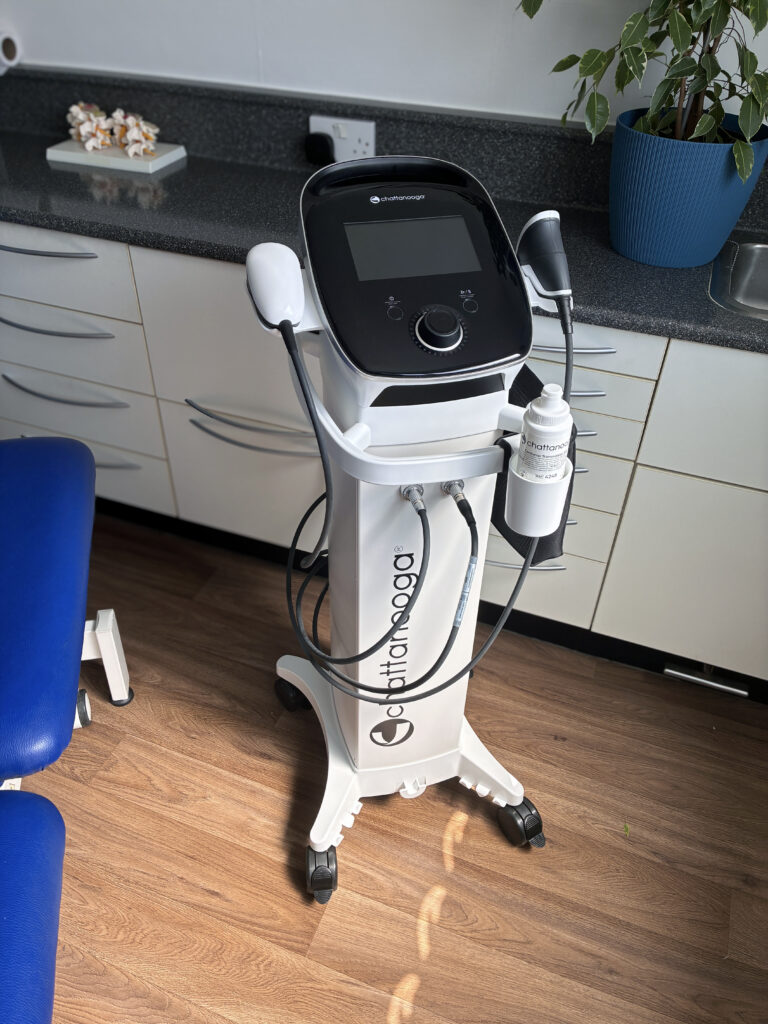
Extracorporeal shockwave therapy (ESWT) employs sound waves to transmit energy into target tissues. Radial Pressure Wave (RPW) devices utilize a pneumatic or ballistic mechanism, yielding distinctive waveforms. These devices generate maximum energy at the skin surface, which decreases with tissue depth according to the device’s settings and applicator specifications.
How Shockwave Works.
Shockwaves produce two principal effects: direct mechanical forces (primary effect) and indirect mechanical forces caused by cavitation (secondary effect). The primary effect results from an abrupt escalation in positive pressure, while the secondary effect occurs during the subsequent negative (tensile) phase. Cavitation refers to the rapid formation, expansion, and collapse of bubbles induced by acoustic waves, facilitating calcific deposit fragmentation, neural stimulation, axonal activation, and pain reduction. The collapse of these bubbles releases high-temperature microjets, causing controlled microtrauma that initiates tissue repair.
Cellular responses to pressure alterations are termed Mechanotransduction—the process by which cells convert mechanical stimuli into biological reactions. This leads to increased cellular proliferation, differentiation, angiogenesis, collagen synthesis, and elevated expression of TGF-1 and matrix metalloproteinases (MMPs), all of which promote recovery.
What does Shockwave do.
- Enhances Blood Flow: Stimulates circulation to support healing
- Stimulates Collagen: Promotes collagen production for tissue restoration
- Reduces Inflammation: Assists in managing chronic inflammation
- Breaks Down Tissue: Facilitates breakdown of scar tissue and calcified deposits.
What does Shockwave treat?
- Plantar fasciitis (heel pain)
- Achilles tendinopathy, tennis/golfer’s elbow
- Patellar tendinopathy (jumper’s knee)
- Rotator cuff tendinitis
- Calcifications: Calcific tendinitis of the shoulder
- Muscle/Soft Tissue: Chronic muscle tension, myofascial trigger points
- Other Injuries: Shin splints (medial tibial stress syndrome), hip bursitis/tendinopathy.
What to Expect During a Session.
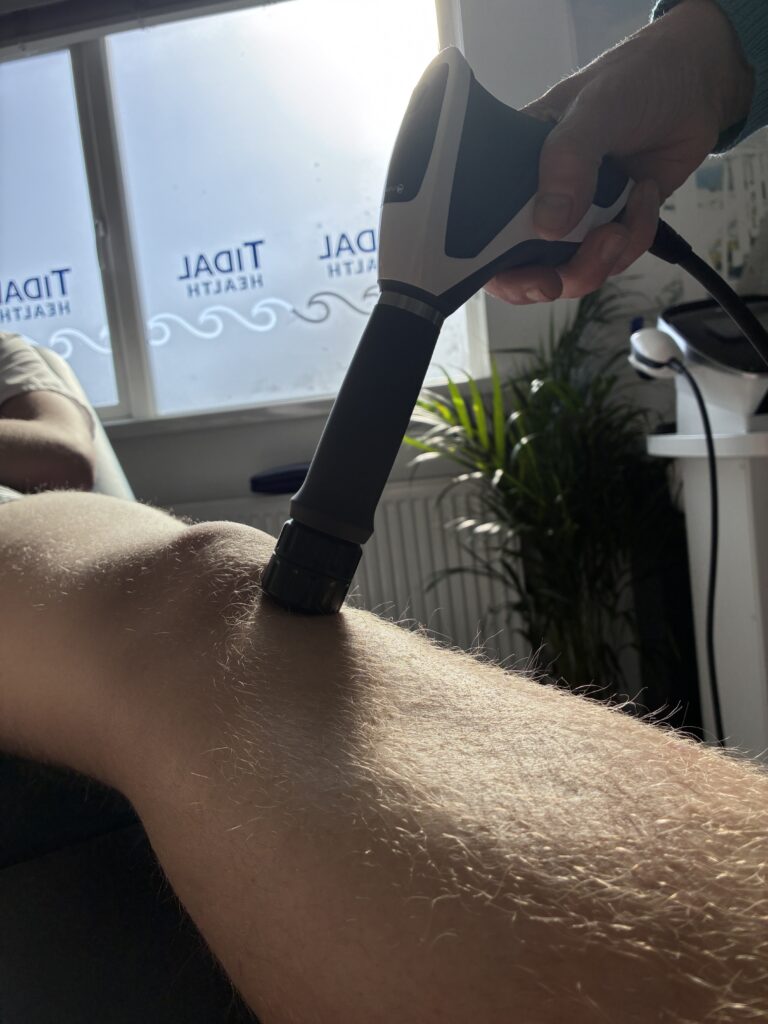
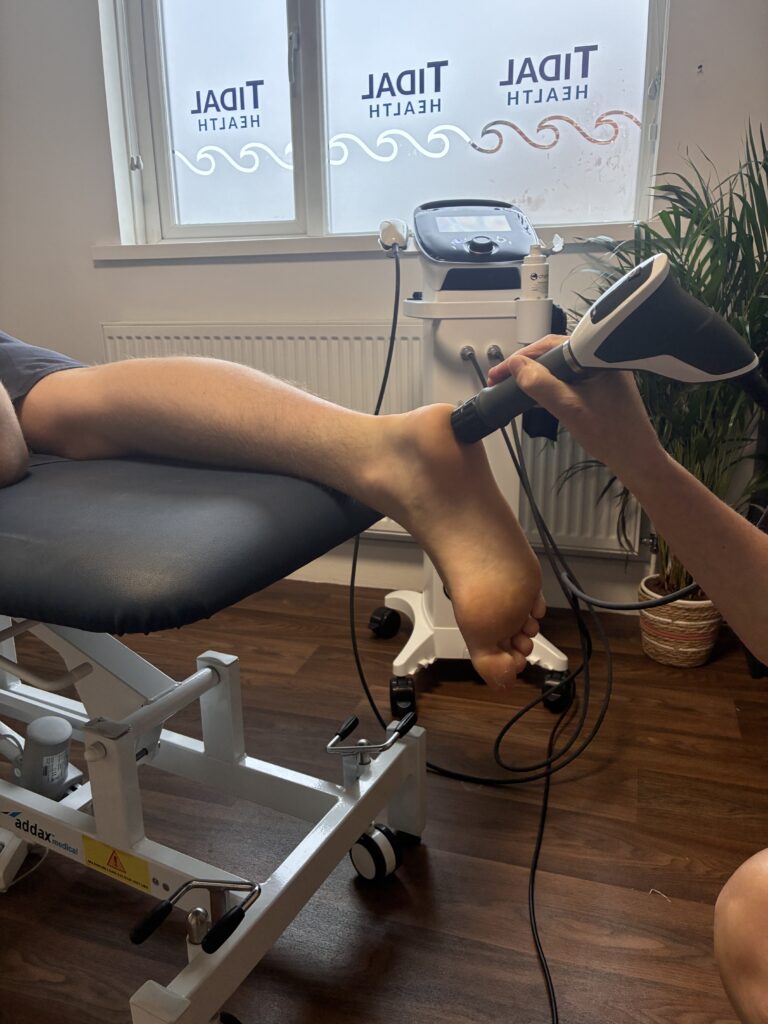
- Preparation: Gel is applied to the treatment area, and a handheld probe delivers therapy, with intensity adjusted for patient comfort.
- Sensation: Patients may experience deep tapping, buzzing, or rhythmic vibration. Discomfort during sensitive area treatment is typical and indicates correct targeting.
- Duration: Sessions last approximately 5–10 minutes, with most conditions requiring three to five treatments.
Post-Treatment Expectations.
- Immediate Side Effects: Mild swelling, redness, bruising, or transient pain may occur.
- Immediate Relief: Some patients report instant pain relief; others require several weeks for full effect.
- Aftercare: Rest the treated area for 24–48 hours and avoid high-impact activity.
Shockwave Contraindications.
(Reasons for a person to not receive a treatment or procedure because it may be harmful)
Absolute Contraindications
- Pregnancy
- Active cancer/tumor at treatment site
- Blood clotting disorders or anticoagulant use
- Infection or open wound at treatment site
- Pulmonary or air-filled tissue regions
- Recent steroid injection (<12 weeks)
- Hemophilia/clotting disorder
- Cardiac pacemaker/device
- Unstable cardiac conditions
- Epilepsy
- Age <18 (except specific cases)
- Use of fluoroquinolone antibiotics
- Osteogenesis imperfecta
- Powered implants (e.g., nerve stimulator)
Relative Contraindications
- Recent steroid injection (6–12 weeks)
- Age <18 (except specific cases)
- Cardiac devices
- Decreased sensation or sensitivity
- Severe tendon/ligament rupture
- Epilepsy
- Anticoagulant medication
- Anti-platelet medication
- Fracture near treatment area
- Underlying prosthetic joint
- Inflammatory diseases (active phase)
- Previous Achilles tendon rupture (until healed)
- Acute tendon/plantar fascia tear
- Increased/decreased sensitivity at treatment site
Frequently Asked Questions.
Are there any side effects from shockwave therapy?
Shockwave therapy can convert a chronic condition to an acute phase, thereby restarting the healing process. Potential minor side effects include heat, redness, petechiae, and soreness, which are uncommon and typically resolve within days.
How long does a treatment session last?
A standard session involves delivery of approximately 2000 shocks at 10–15Hz, lasting 2–3 minutes per area. Analgesic effects are common, enabling adjunct manual or exercise therapy.
Is exercise permitted after shockwave therapy?
Strenuous or high-impact activities should be avoided for 48 hours post-treatment. Routine low-impact activity and practitioner-recommended rehabilitation exercises are acceptable.
Does shockwave treatment hurt?
Shockwave therapy may cause mild to moderate discomfort, typically described as pulsing, tapping, or deep aching—especially over bony areas. Intensity is adjustable, and discomfort usually resolves within 24–48 hours.
Are there any reasons I couldn’t have shockwave therapy?
There are a few absolute contraindications and some relative contraindications (Contraindications – “Reasons for a person to not receive a treatment or procedure because it may be harmful”).
How much does shockwave cost?
Cost will depend on the number of treatments that you require, this will be discussed with your therapist at your initial consultation & treatment appointment, who will give you an idea of the number of follow up treatments you may require.